The SI Joint & Estrogen: Why Stability is the New Flexibility
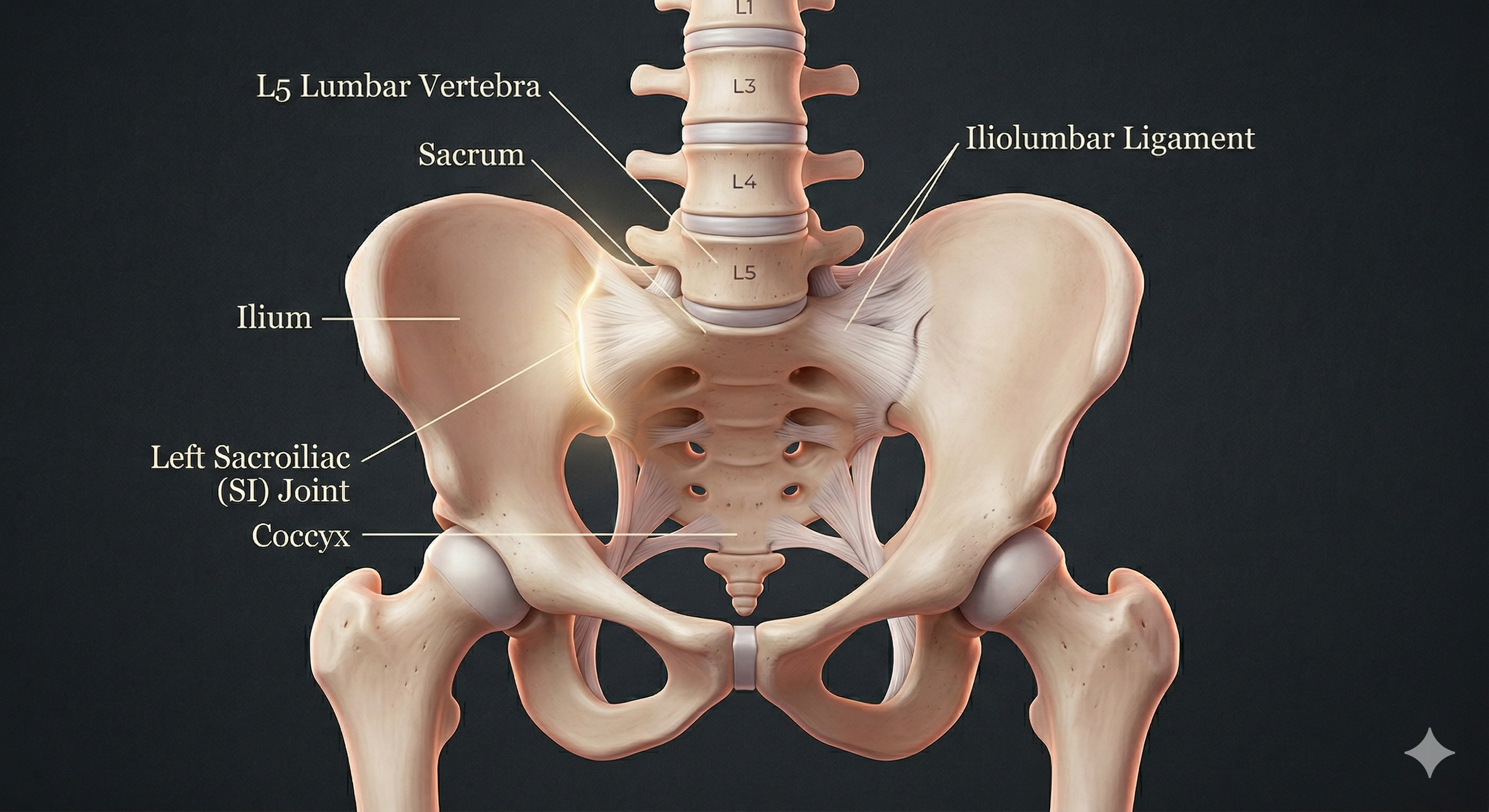
For decades, the wellness industry has whispered a single command to women: "Stay flexible." We are told to stretch, to reach, and to lengthen. But as we enter the Second Spring, the physiological "rules of engagement" change. In this phase, true vitality isn't found in how far we can bend, but in how well we can hold our center.
The Silent Shift: Estrogen and Your Ligaments
Most women recognize estrogen as a regulator of the reproductive cycle, but its influence reaches far deeper into the architectural "duct tape" of our bodies: Collagen. Estrogen is a key driver of collagen synthesis and water-binding capacity within our connective tissues.
As estrogen levels begin their rhythmic decline during perimenopause, our ligaments—the fibrous bands that hold bone to bone—can lose their "snap." This phenomenon is known as Ligamentous Laxity. While you might feel "looser" in certain stretches, this lack of tension is often the hidden culprit behind the nagging, dull ache in the lower back and hips that characterizes the 45-65 age demographic.
The SI Joint: The Anchor of the Second Spring
The Sacroiliac (SI) Joint is the critical intersection where your spine meets your pelvis. Unlike the shoulder or hip, the SI joint is not designed for wide-range movement; it is a "shock absorber" that relies on friction and tight ligamentous support to stay aligned.
When hormonal shifts introduce laxity into this anchor point, the joint can undergo "micro-misalignments." These tiny shifts trigger a cascade of protective muscle guarding in the glutes, hamstrings, and lower back. This is why many women feel like they need to stretch their hamstrings constantly—not because the muscle is short, but because it is trying to stabilize a "wobbly" pelvis.
The Sanctuary Protocol
The Rule of Symmetry: In this phase of life, asymmetrical "stretches" like Pigeon Pose or deep lunges can actually pull the SI joint further out of place. Shift your focus to Symmetrical Isometrics. Engaging the inner thighs (adductors) creates a "compressive wrap" around the pelvis that mimics the stability estrogen used to provide.
From Stretching to Structural Engagement
To navigate this shift with grace, we must move from passive movement to active engagement. Passive stretching—letting gravity pull you into a shape—can overstress the already lax ligaments. Instead, the "Spring Phase" movement philosophy prioritizes Isometrics and Midline Engagement.
Imagine your pelvis as the center of a clock. Instead of trying to reach for "12" or "6," focus on drawing everything in toward the center point. This "hugging of the bone" protects the nerves exiting the sacrum and prevents the inflammation of the mucosal lining within the joint itself.
Physiological FAQs: SI Stability
Why does my lower back ache more after 50?
Declining estrogen reduces the water-binding capacity of ligaments, leading to joint instability. This instability causes the surrounding muscles to "clamp down" in a protective spasm, which we perceive as a chronic, dull ache in the lower back or upper glute area.
<div>
  <h4 style="color: #7B2CBF; font-weight: 800; font-size: 1.1rem; margin-bottom: 0.5rem;">Is it safe to do Yoga with SI Joint pain?</h4>
  <p style="color: #6b708d; line-height: 1.8;">Yoga is highly beneficial, provided you prioritize stability over depth. Avoid deep "end-range" stretches. Instead, focus on "Bridge Pose" and "Mountain Pose" while consciously drawing the sitting bones toward each other. If a pose feels "crunchy" or sharp in the back, back out immediately—that is your body signaling a lack of structural support.</p>
</div>

<div>
  <h4 style="color: #7B2CBF; font-weight: 800; font-size: 1.1rem; margin-bottom: 0.5rem;">Can a vegetarian diet impact joint stability?</h4>
  <p style="color: #6b708d; line-height: 1.8;">Yes. Vegetarians must be intentional about <strong>Amino Acid profiles</strong> (the building blocks of collagen). Ensure you are getting adequate Glycine, Proline, and Vitamin C—all of which are required for the body to repair the connective tissue that estrogen is no longer maintaining at its previous rate.</p>
</div>
Frequently Asked Questions
Why does my lower back ache more after 50?
Declining estrogen levels lead to ligamentous laxity, making the SI joint less stable and causing micro-misalignments.
Is it safe to do Yoga with SI Joint pain?
Yes, but prioritize stability over depth. Avoid deep asymmetrical stretches and focus on symmetrical poses like Bridge.
Weekly Physiological Briefings
Clinical insights and nervous system rituals delivered once a week. No noise. Just wisdom.
Want this protocol molded to your specific rhythm?
Talk to the Sanctuary Guide to adjust these insights for your bio-individual needs.